
CLB History of North American Mission
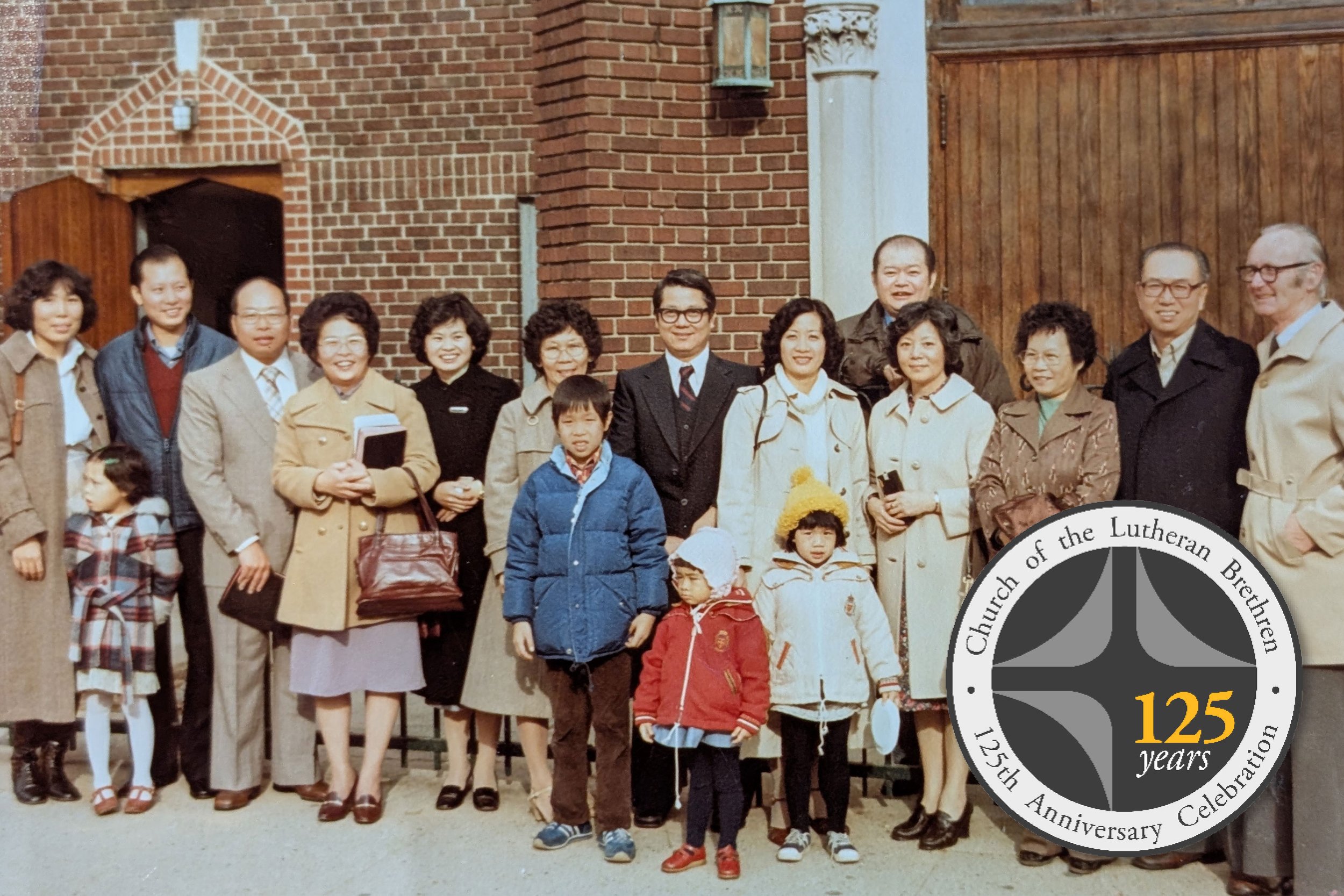
Adaptation of the Script for Part 4: NAM Beginnings—A Four-Part Documentary on the History of the CLB.
A Judahite named Jabez once offered up a simple prayer to the God of Israel: “Oh that you would bless me and enlarge my border, and that your hand might be with me, and that you would keep me from harm.” And God, we are told, granted his request (1 Chronicles 4:10).
At the Church of the Lutheran Brethren founding convention in Milwaukee, Wisconsin, in December 1900, one of the first agenda items for the new denomination, after the election of an inaugural executive board, was the matter of how to carry out “the Innermission.” The minutes for Tuesday morning, December 18, read:
In regard to the Innermission, the following motion was accepted: the conference recommends the Innermission to the churches and promotes its encouragement. The leadership is authorized to begin this whenever possible.
Here, “the Innermission” refers to special evangelistic meetings or campaigns in the Haugean Lutheran tradition―whether in a church building, a schoolhouse, a home, or an open-air tent―with the aim of converting people from spiritual darkness and indifference to a conscious, living faith in Jesus Christ.
The formation of the Church of the Lutheran Brethren in 1900 was in many respects a direct byproduct of “innermission” evangelistic work among Norwegian immigrants during the 1890s. Now itinerant evangelistic work would be promoted by the fledgling CLB for two reasons: the spiritual and numerical growth of existing congregations and the potential formation of new, living Lutheran congregations wherever newly converted Lutherans were desirous of separating themselves from spiritually dead or indifferent congregations.
In practice, few if any new congregations came into existence as a result of the CLB’s early commitment to itinerant evangelism, even though CLB evangelists did have the privilege, as one observer put it, of “lead[ing] men to a right relationship with God wherever the door was open to preach.” Existing congregations were both invigorated and enlarged by means of CLB-sponsored evangelistic campaigns and summer tent meetings in North America. E. M. Broen was perhaps the most gifted Norwegian American evangelist of his generation and twice stepped away from his teaching and administrative duties at the Lutheran Bible School―from 1912 to 1914 and again from 1926 to 1931―to devote himself to full-time evangelistic work on behalf of the synod. At one point in 1928, Broen conducted three months of continuous special meetings in Brooklyn, New York, preaching every evening and twice on Sundays. It is perhaps no mere coincidence that 59th Street Church of Brooklyn would remain the CLB’s largest congregation throughout the middle decades of the twentieth century, with Sunday school enrollments alone approaching 1,000 by 1946.
Despite the lack of any organized plan or strategy to establish new congregations during the first fifty years of its existence, the CLB did in fact continue to grow steadily as a denomination throughout the first half of the twentieth century. The dissemination of the Lutheran Brethren brand of spirituality and congregational polity by means of Broderbaandet magazine, traveling Lutheran Brethren evangelists, and Lutheran Bible School graduates helped to draw a certain number of like-minded Norwegian-speaking Lutheran congregations into CLB affiliation and membership. From the original five congregations of 1900, the CLB grew to 25 congregations by 1918, 31 congregations by 1938, and 37 congregations by 1950.
Still, this pattern of casual, organic growth for the CLB in America and Canada was deemed inadequate and unsustainable by some within the synod, who rued the fact that “proportionally little manpower and money” was directed toward the establishment of strong congregations in North America in comparison to the CLB’s extensive involvement in church planting initiatives overseas. Commenting at the mid-century mark on the somewhat neglected status of Lutheran Brethren home mission work, long-time synodical treasurer M. J. Quarum noted that “this branch of our work has never really caught fire amongst us as the foreign missions work has.” Quarum voiced the sentiments of others within LBS and synodical leadership at the time when he urged that “a healthy and strong condition in our own home [mission] work is fundamental to the work of our entire synod.”
CLB synodical expenditures in the 1940s, in fact, reveal a growing commitment in the post-E.M. Broen years to other types of “home mission” involvement besides itinerant evangelism and tent meetings. Member congregations in North America that were struggling to stay afloat financially, or that were in need of loans to help with a building project or a mortgage, could appeal to the CLB mission board for financial assistance.
In 1954, delegates at the annual convention in Fergus Falls, Minnesota, approved a landmark constitutional amendment that dissolved the long-standing CLB Mission Board and replaced it with two new independent boards: a Board of Foreign Missions and a Board of Home Missions.
With newfound freedom to direct congregational affairs on the home front, the newly constituted Home Missions board quickly jumped into action. Pastor Joseph Rangen was called as the first part-time Home Missions director and, along with his wife Estelle, moved from Colfax, Wisconsin, to the Fargo-Moorhead area in the summer of 1954 to begin a new church-planting venture with full synodical backing. The Rangens conducted outdoor meetings in Oak Grove Park in Fargo that summer before holding their first indoor worship service in their own home on September 12th, 1954, with twenty-two in attendance. Triumph Lutheran Brethren Church was formally organized in Moorhead, Minnesota, in February 1955, with Rangen serving as its full-time pastor from 1957 to 1962. Triumph has since grown to become one of the largest congregations in the CLB today, with over 1,000 worshipping on a weekly basis across two campuses in Moorhead, Minnesota, and West Fargo, North Dakota.
With its new “Mission to America” emphasis, the Home Mission board was instrumental in helping to establish more than twenty new Lutheran Brethren congregations in Minnesota, North Dakota, Montana, New York, New Jersey, Oregon, South Dakota, Washington, California, Alberta, and Saskatchewan during its first ten years of existence.
Pastor Harland Helland, a son of Bethany Lutheran Church in Kenyon, Minnesota, was the founding pastor for two of those new church plants―Our Redeemer’s Lutheran Brethren Church in Minot, North Dakota (organized in 1958), and Maple Park Lutheran Brethren Church in Lynnwood, Washington (organized in 1962). In the summer of 1968, Helland accepted a call to become the first full-time director of Lutheran Brethren Home Missions. Under his visionary and enthusiastic leadership as a well-seasoned planter of churches, Harland Helland would oversee a decade and a half of dramatic church growth for the CLB. By the end of Helland’s tenure as Home Missions director in 1984, the Church of the Lutheran Brethren would have gained an additional 46 congregations, many from states and provinces that had previously lacked any organized Lutheran Brethren presence: Idaho, Rhode Island, Arizona, Florida, Colorado, Pennsylvania, and British Columbia.
Several other channels for fruitful, ongoing ministry on the home front emerged within the Church of the Lutheran Brethren throughout the course of the twentieth century as well. Six different elder care centers―three in Minnesota, two in Arizona, and one in Texas―have been established by the CLB over the past 110 years, dating back to the opening of Sarepta Home for the Aged in Sauk Centre, Minnesota, in 1916. Today, LB Homes of Fergus Falls, Minnesota, remains the solitary elder care center in North America that continues to affiliate with the Church of the Lutheran Brethren.
The first large-scale CLB-sponsored youth conference took place in Grand Forks, North Dakota, in July 1914. It was a resounding success, lasting for nearly two weeks with an estimated overall attendance of 500. The following year, Fergus Falls was chosen as the venue for the second LB youth convention, with more than 650 in attendance. Annual or biennial youth conventions have continued to be a staple feature of CLB synodical ministries in North America, right up to our current biennial “Elevate” events.
Along a similar vein, women’s ministry organizations and societies that existed at the local level in virtually every CLB congregation finally took the step of organizing a national women’s association called the Women’s Missionary Fellowship in 1954. Since then, synod-wide gatherings of women from dozens of local WMF and Women’s Ministries chapters have taken place in conjunction with every CLB annual or biennial convention.
One additional legacy that has evolved out of the CLB’s early emphasis on evangelism, biblical preaching, and inter-congregational fellowship is the “Bible camp” tradition, which continues to thrive at a regional level across the denomination. The first CLB-sponsored Bible camp took place near Battle Lake, Minnesota, from June 24 to July 4, 1926. By 1942, the CLB was sponsoring similar summer Bible camps in rental facilities on an annual basis. Inspiration Point Lutheran Bible Camp became the first CLB owned-and-operated Christian conference center when land was purchased in 1961 on a peninsula jutting out into Lake Spitzer at Clitherall, Minnesota. A similar CLB-affiliated Christian conference center began operations in 1972 when Tuscarora Inn was purchased along the banks of the Delaware River in Mt. Bethel, Pennsylvania, by some CLB businessmen. Today, thousands of campers and guests are ministered to each year at IPoint in the Upper Midwest and Tuscarora Inn on the East Coast. Many within CLB congregations today can look back with gratitude upon their own spiritual awakening or conversion experience at a CLB-sponsored youth convention, youth camp, or family camp.
The Lord has indeed been faithful to the Church of the Lutheran Brethren throughout the 125 years of our existence, enlarging our borders many times over both here in North America and in other regions of the world. By means of his great faithfulness to us, we have held true to our founding commitments to the living Word of God and a living faith in Jesus Christ, and to the ideal of living Lutheran congregations. This has enabled the CLB to become what it is today—the longest-standing Lutheran Church body in North America that has neither experienced a denominational split nor been merged into another denomination.
Soli Deo Gloria.
To God alone be the glory.
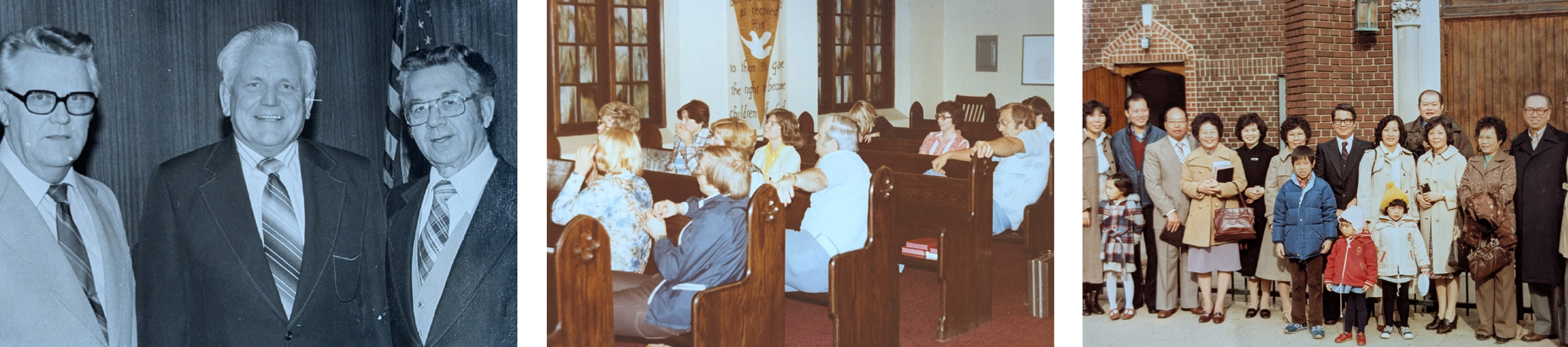
Left: Home Missions (L-R) - Burton Bundy, Harland Helland, and Joe Rangen. Center: Church plant in Appleton, WI.Right: 59th Street Church, NY, Chinese Language Ministry.